 Elyum Jniye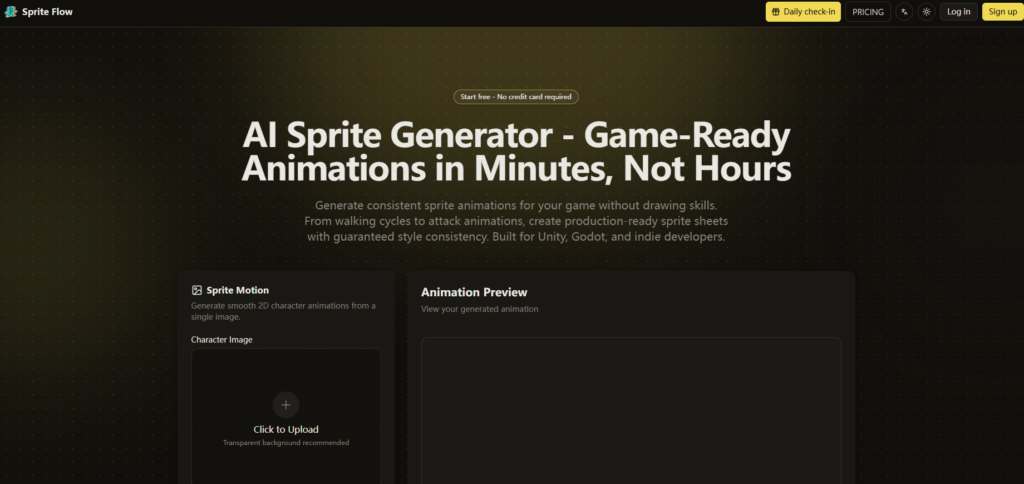
For the past several months, a quiet but persistent topic has dominated conversations in indie game development circles: the rising cost of 2D sprite production. With inflation affecting freelance rates and the demand for high-quality 2D visuals at an all-time high, many solo developers are finding themselves priced out of the art they need. A single, polished character with eight animations can easily command four figures from a professional pixel artist, and that is before considering the iterations, revisions, and the inevitable style drift that occurs when a single artist spends weeks on the same project. This financial barrier has led many to explore alternative workflows, and one name that consistently appears in budget-conscious discussions is AI Sprite Generator. Unlike generic art tools, this platform is built around a specific economic proposition: reducing the cost of a complete character from thousands of dollars to a fraction of that amount, while maintaining the visual consistency that makes a game feel professionally crafted.
Breaking Down the Traditional Cost Structure of Sprite Creation
To understand the value proposition, it is necessary to examine what developers are actually paying for when they commission or create sprites manually. The cost is not simply the hourly rate of an artist; it includes the time spent on revisions, the overhead of managing an outsourced relationship, and the opportunity cost of delayed development. A typical 16-bit character with a walk cycle, idle, attack, jump, and hit animation can take between 40 and 80 hours to complete, depending on the complexity and the number of frames per animation. At a freelance rate of $25 to $50 per hour, that single character represents an investment of $1,000 to $4,000. For a game with ten unique characters, the art budget alone can exceed $20,000 before a single line of gameplay code is written.
The Hidden Cost of Style Inconsistency
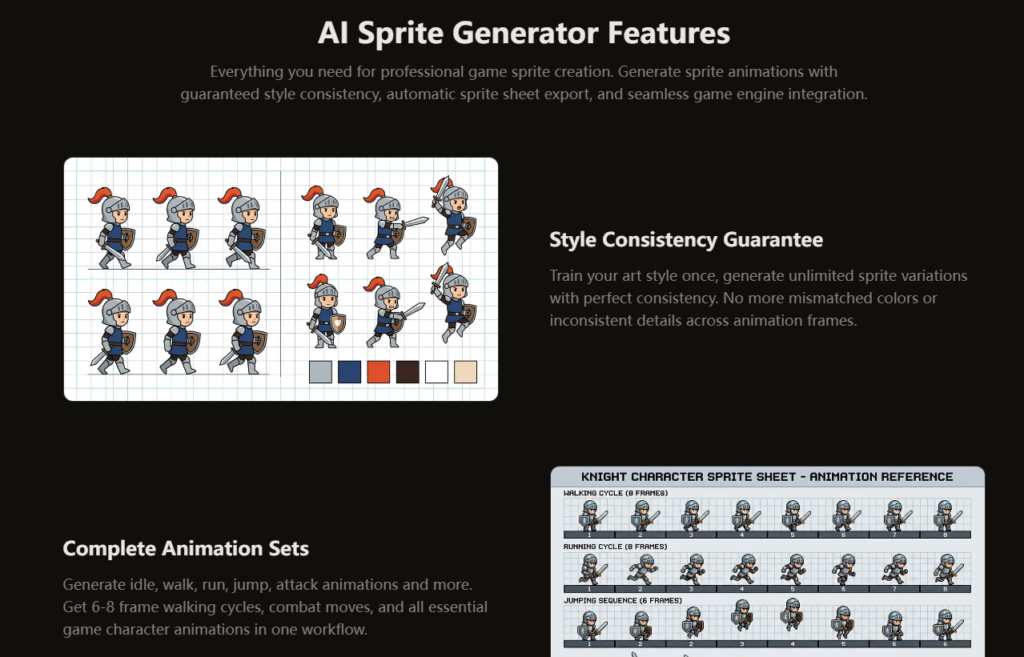
Beyond the direct financial outlay, there is a less obvious expense: the cost of fixing inconsistent art. When a character is drawn over several weeks, subtle shifts in color palette, line thickness, and proportion are almost inevitable. These inconsistencies become glaring when the character is animated, as frames that do not share a unified visual language break the illusion of a single, coherent entity. The platform addresses this by locking color palettes, line thickness, and proportions across all generated frames, ensuring that every sprite matches the established aesthetic. In practical terms, this means the character generated today will visually align with the character generated six months from now, eliminating the costly rework that often plagues long-term projects.
A Practical Cost Analysis: One Character, Two Workflows
To move beyond theoretical discussion, let us examine a concrete scenario: a solo developer creating a platformer with a single protagonist requiring six animations—idle, walk, run, jump, attack, and hurt. Under the traditional manual workflow, this project would require approximately 20 to 30 hours of concentrated pixel art work, assuming the developer has the necessary skills. If the developer lacks those skills and must hire an artist, the cost rises to $500 to $1,500 for a single character, with no guarantee of timely delivery or perfect style matching. The platform offers a different economic model: a complete character with all animations can be generated in roughly 20 minutes, at a cost that is orders of magnitude lower. The platform’s stated value proposition is 10x faster production compared to tools like Aseprite, which translates directly into reduced labor costs and faster time-to-market.
Scaling Characters Without Scaling Costs
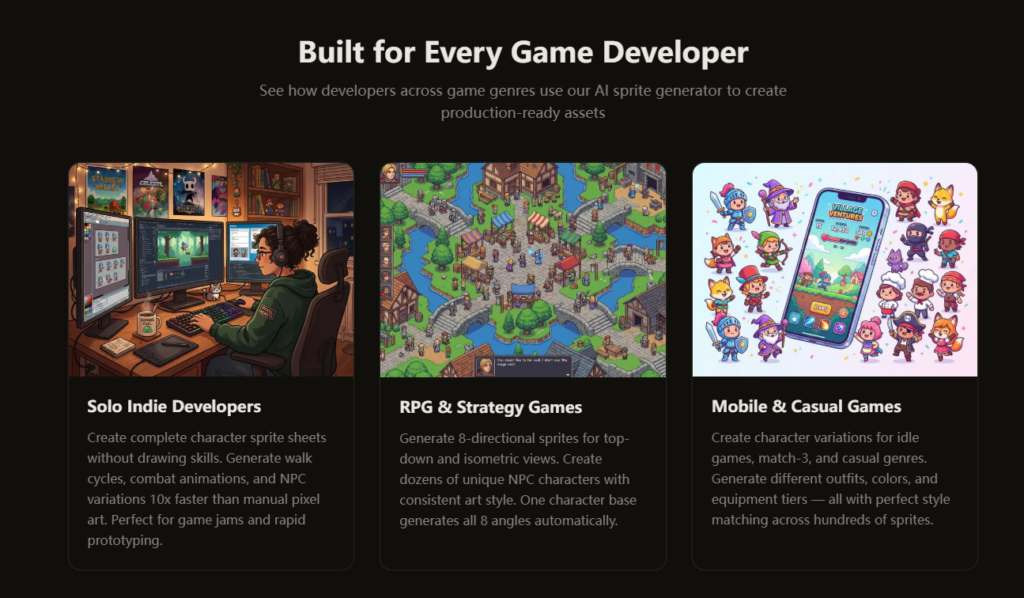
Where the financial advantage becomes most pronounced is in character variation and NPC generation. In traditional workflows, creating a palette swap or an outfit change for a character requires redrawing every frame of every animation, effectively doubling or tripling the production time. The platform allows developers to adjust style settings—changing outfits, colors, or equipment—and regenerate a complete character in approximately three minutes. This capability transforms the economics of game development: a developer can now afford to populate a village with twenty unique NPCs, each with distinct clothing and colors, without multiplying the art budget by twenty. For RPGs and strategy games that require large casts, this feature alone can reduce the total art cost by 80% or more.
The Export Pipeline: Where Time Translates to Money
The financial analysis does not end with generation; it extends to the integration phase. In a manual workflow, after the sprites are drawn, the developer must slice the sprite sheet, name each frame, configure the animation controller, set up collision boxes, and test the timing in the game engine. This integration work can add several hours per character, particularly for developers who are not familiar with the nuances of Unity’s Animator or Godot’s AnimationPlayer. The platform’s one-click export to Unity, Godot, and Unreal Engine includes sprite sheet atlases, JSON metadata with frame positions and durations, animation controller presets, and suggested collision boxes. This means the character is not just generated; it is delivered in a state that is ready to drop directly into a project. The time saved on integration is time that can be spent on gameplay, level design, or polish—activities that directly contribute to the game’s quality and marketability.
A Comparison of Development Economics
To visualize the cost and time differences, consider the following comparison based on the platform’s stated metrics and industry benchmarks:
|
Cost Factor |
SpriteFlow AI Workflow |
Traditional Manual Pipeline |
|
Time per Character (6 Animations) |
~20 minutes |
20–40+ hours |
|
Cost for Solo Developer (Time Value) |
Negligible |
$500–$2,000 (opportunity cost) |
|
Cost for Commissioned Art |
Fraction of professional rates |
$500–$5,000 per character |
|
Character Variation Time |
~3 minutes per variant |
20+ hours per variant |
|
Engine Integration Time |
One-click export with metadata |
1–3 hours per character |
|
Style Consistency Risk |
Palette-locked, proportion-constrained |
High; requires deliberate maintenance |
|
Scalability for NPCs |
Linear cost scaling |
Exponential cost scaling |
Limitations That Affect the Economic Equation
While the financial advantages are substantial, the platform is not a universal solution for every art need. The quality of the output is directly tied to the quality of the input; vague or overly complex character descriptions may require multiple generation attempts, which, while still faster than manual work, introduces some variability into the workflow. The platform’s own documentation suggests that reference images improve results, and developers who invest time in training the AI on their specific style will see more consistent outcomes. Additionally, for hero characters or flagship assets where every pixel is scrutinized, the generated sprites may serve better as a base for manual refinement rather than a final product. The platform does not claim to eliminate the need for artistic touch-ups, and several user reviews describe a hybrid workflow: AI for volume and consistency, manual tools like Aseprite for polish and hero characters. This pragmatic approach acknowledges that while the platform dramatically reduces costs, it is most effective when integrated into a broader production pipeline rather than treated as a complete replacement.
Who Benefits Most from This Economic Model
The platform’s financial structure is particularly well-suited to specific developer profiles. Solo indie developers with limited budgets and no art background represent the primary audience; the platform eliminates the need to hire an artist or spend months learning pixel art. Game jam participants, who operate on 48-hour deadlines, benefit from the ability to generate presentable characters in minutes rather than days. Small teams working on RPGs or strategy games, which require large numbers of NPCs and 8-directional sprites, can use the platform to scale their art production without scaling their budget. For these users, the AI Sprite Generator is not merely a convenience; it is a financial necessity that makes certain types of games economically viable. The platform’s free tier allows developers to test the workflow before committing, and paid plans are structured to fit indie budgets. In an industry where the gap between a great idea and a finished game is often measured in financial resources, any tool that narrows that gap deserves serious consideration.